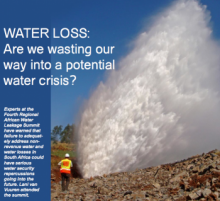
The summit, held in Midrand, is the brain-child of Dr Ronnie McKenzie, MD of WRP Consulting Engineers, and follows on from the successful series of water demand management workshops and water demand management Master classes presented annually by WRP since 1997.
Endorsed by the International Water Association, with sponsorship from WRP, Rand Water and the Water Research Commission, the 2014 event was the most popular yet, attracting over 180 delegates from eight countries. The main aims of the summit were to create general awareness of the need to manage water losses throughout South Africa, and to highlight the status quote as far as water resources and progress in addressing losses each year.
That South Africa is not yet taking the importance of water loss control seriously enough ran as a key message through most of the presentations at the Summit. And the warning that this could have serious repercussions in areas where maximum water supply levels have been reached was too loud to ignore.
|
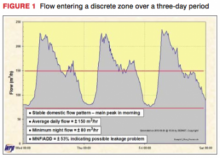
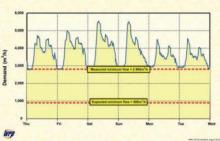
REMOTE LOGGING, through GSM and GPRS devices in particular, is commonplace and easily accessible to all water suppliers in virtually every country. The costs associated with both the hardware and the software, as well as associated communication charges, have all decreased in recent years with the result that the financial viability of using such technology to assist with leakage reduction activities is now clearly evident. This article will provide a brief over view of the use of flow and pressure loggers in a water reticulation system to highlight the value of such information as part of any leak- age reduction programme. The interpretation of minimum night flows (MNF) and various pressure checks will be discussed using a number of practical examples to demonstrate how such logging results can be analysed. It will also present details and interesting examples from a wide variety of case studies under taken throughout Southern Africa using some of the latest internet-based data acquisition and display systems. Such technology is now widely available to virtually every water supplier in the world and the benefits of proper monitoring and rapid response to problems is without doubt one of the most effective measures in driving down leakage. The remainder of this article will explain some of the key issues associated with both flow and pressure logging and provide some examples to highlight the value of such logging.
|
The South African Water Research Commission assists South African utilities in managing leakage, and has used leakage data to put together a comprehensive assessment of non-revenue water in the country. In the latest article from the IWA Water Loss Specialist Group, Jay Bhagwan, Willem Wegelin and Zama Siqalaba discuss the outcomes of South Africa's largest leakage assessment to date.
The South African Water Commission (WRC) has been providing support to municipalities throughout South Africa to address leakage wastage from their potable reticulation systems since the early 1990s. South Africa was one of the first countries outside the UK to fully recognise the benefits of adopting the Burst and Background Estimate (BABE) methodology that was initially developed by the UK water industry when the major water suppliers in England and Wales were privatised in the early 1990s.
|
While South Africa’s non-revenue water levels compare well internationally as a water scarce country we need to do all we can to prevent the unnecessary loss of water. This is one of the main recommendations of a recent study into the state of non-revenue water in South Africa commissioned by the Water Research Commission (WRC). Lani van Vuuren reports.
The Draft Second National Water Resources Strategy (NWRS2) has identified the implementation of water use efficiency, conservation and water demand management as a core strategy to ensure sufficient water to meet South Africa’s needs going into the future. This, ‘non-negotiable performance area’, it says, must be implemented immediately in all water use sectors, specifically municipalities. “In view of water scarcity, it is essential that such water losses must be curtailed, especially in terms of the need to provide for the growing water demands of new socio-economic development,” the strategy points out.
In order to improve the current situation, the water sector must have a clear indication of the current status of non-revenue water in South African municipalities, more specifically what the actual water losses are and how they are split between physical leakage (real losses) and commercial losses (apparent losses). It is for this reason that the WRC, in collaboration with the Department of Water Affairs (DWA), launched the latest investigation into the state of non-revenue water in South Africa, which has now been published.
|
With a water shortage predicted by 2020, leaking pipes, ageing infrastructure and poor municipal administration is exacerbating South Africa’s water crisis.
With billions of rands of public funds being wasted annually, Water and Environmental Affairs Minister Edna Molewa has recently revealed that a quarter of the country’s water was being lost due to leaking water systems.
Current deficit
According to a survey conducted by the Department of Water Affairs that looked at the long-term water requirements for all the municipalities, 30% of towns in South Africa are currently running at a water deficit. The minister also warned that a water shortage was a reality by 2020 if South Africans do not work together to conserve this precious commodity.
|
Many water distribution systems in South Africa are deteriorating due to many years of neglect, resulting in a serious maintenance backlog. Aiming to find a solution to this, one of the largest advanced pressure management projects in the world was undertaken, which successfully tackled water losses and improved network management. Ronnie McKenzie and Willem Wegelin discuss the project’s innovative public-private partnership approach.
Emfuleni Local Municipality is located to the south of Johannesburg in the industrial heartland of South Africa. A separate water utility called Metsi-a-Lekoa was established several years ago to manage the supply of potable water to approximately 1.2 million residents of the municipality, 450,000 of which are located in the Sebokeng & Evaton areas. Water is supplied to Metsia-Lekoa from the local bulk water provider, which is one of the largest providers of potable bulk water in the world.
|
W&S Africa reports on the project that aims to reduce Emfuleni Municipality's total water demand by 15%
A Memorandum of Understanding (MoU) on the Emfuleni Water Conservation Project has recently been signed by the Emfuleni Municipality and the Deutsche Gesellschaft fur Internationale Zusammenarbeit (GIZ) GmbH on behalf of the German, British and Australian governments, as well as Sasol.
Speaking at the signing ceremony, chief director for Emfuleni's Metsi-a-Lekoa water services unit, Thembi Mkhize, explained the environmental and financial importance of this partnership: "The three-year project aims to significantly reduce the amount of water wasted through leakages and thereby save Emfuleni money. By the end of the third year, a 15% reduction in total water demand would equate to an annual reduction of 12 million kilolitres (12 billion litres) or expense of some R62 million, compared to the 2010 baseline." The water conservation and demand management project was officially launched as part of the Gauteng Water Sector Forum, held at Gallagher Estate.
|
This year's African Water Leakage Summit highlighted the growing importance of water loss control in the African environment.
The two events, each held over two days in both Johannesburg and Cape Town, attracted more than 200 delegates in total, from nine countries. This is the first African regional water losses summit to be officially sanctioned by the International Water Association.
This year's event was a joint effort involving the private and public sectors, with WRP as the main organiser and supported by many organisations, including the South African Department of Water Affairs, the South African Water Research Commission, the Development Bank of South Africa (DBSA), The City of Tshwane, Sasol, the German Government (GiZ), British Government (DFID) and the Australian Government (AusAid)
|
Water management is becoming increasingly complex as water becomes an increasingly scarce commodity in a semi-arid country like South Africa
Water management companies like WRP Engineering are working hard to develop viable methods of sustainable service delivery and they are contributing to the economic growth of South Africa by meeting present and future need for potable water.
Water Resource Planning and Conservation (WRP) Engineering is a specialist engineering consultancy of international standing in the field of Water Resources Planning and Management, as well as Water Conservation and Environmental Management. WRP provides professional services to ensure the sustainability of projects and maintain the integrity of the environment. Through the diverse talents of its staff, dedicated leadership and international alliances, WRP focuses on the development of innovative and cost effective solutions to promote efficient management of water related services. WRP is partly owned by the Miya Group of Luxembourg and is a world renowned company in water conservation projects. WRP is responsible for the design and building of the three largest water pressure management installations in the world, winning the company many awards and accolades, including the prestigious Africa Energy Award for Best Demand Side Management Project 2010.
|
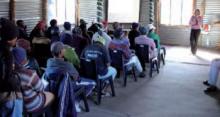
For water demand management programmes to become a sustainable part of improving water supply services in low to middle income countries, community awareness and education needs to be addressed. In the latest article from the IWA Water Loss Specialist Group, Ronnie Mckenzie, Zama Siqalaba and Willem Wegelin highlight a number of projects in South Africa where successful leak management was undertaken with support from the local communities.
Reducing water losses and other forms of wastage from water reticulation systems in South Africa is becoming one of the most important issues facing the country, as was recently highlighted in the President’s ‘State of the Nation’ speech in February 2010. A nationwide target reduction in domestic water use of 15% over the next five years has been tabled in Parliament and major efforts are currently being made to identify appropriate funding opportunities to support the required interventions.
|