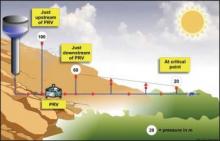
IN MANY PARTS OF South Africa, pressure management is by far the most important water demand management (WDM) intervention and is often the first to be implemented.
Although it must be acknowledged that this is not the answer in every case, it is often one of the most cost-effective measures for reducing leakage and wastage that can be considered.
South Africa was one of the first countries in the world to adopt the principles of advanced pressure control, initially developed in the UK for its water industry in the early 1990s. The techniques used in the UK were first presented in South Africa in 1997, and following a series of small pilot projects, the full-scale Johannesburg Pressure Management Project was completed in 1999, involving the design and commissioning of almost 50 advanced pressure control installations (Mckenzie, Wegelin & Rhoner, 2000). Although this project was completed more than 12 years ago, the City of Johannesburg has since then been maintaining and operating the equipment to ensure that the benefits of advanced pressure control remain sustainable. One of the original controllers was recently serviced with a new battery – after eight years of continuous use.